Septic alarm going off? What it means and what to do first
Updated
A septic alarm is telling you one of two things. Either the water in the pump tank is too high, or on an aerobic system, the aerator has stopped pushing air. Those need different responses, so the first job is to tell them apart.
Which alarm is it
Open the panel door. The legend printed inside tells you what each light means, but the convention is:
- Steady red light: high-water alarm. Water in the pump tank has risen past the alarm float. Every pumped system and every aerobic unit has this one.
- Yellow, amber, or flashing red light: aerator alarm. The panel’s pressure sensor on the aerator’s air line sees low pressure, or on some brands the aerator has stopped drawing current. Only aerobic treatment units have this one.
- Both lit: treat it as high water and call. On some panels the pair also means a sensor fault.
- Green light off, with red on: the panel itself has lost power. Start with the breaker.
If your panel has only one alarm, it is the high-water alarm.
Silence it
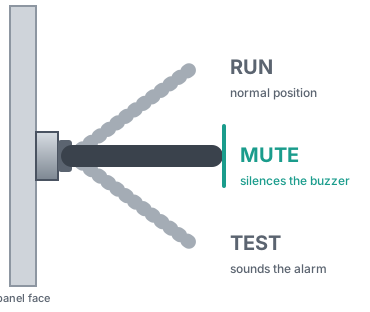
Most panels have a three-position toggle switch for the alarm: run at the top, mute (or silence) in the middle, test at the bottom. Flip it to the middle. The lamp stays lit until the problem clears, so you lose nothing by silencing the buzzer, and it lets you think. Flip it back up to run once the lamp goes out, or the next alarm will be silent. Some panels use a push button instead; it does the same thing.
Do not open the tank or try to free a float yourself. The gases in a septic tank can kill, and a float is a job for someone with the right gear.
If it is the aerator alarm
The aerator is the small air pump above ground, usually in a housing near the tank or beside the panel. It should run all the time, or on a timer on some brands, pushing air to the treatment chamber. Without that air the bacteria that treat the water begin dying off within a day or two, so get it fixed in that window. It is not the same emergency as high water, since the pump is still moving water out, but it is not a someday job either.
Check, in order:
- Is the aerator getting power? It is usually on its own breaker. A tripped breaker is the most common cause and the easiest fix. If it trips again on reset, stop and call.
- Is it running? Put a hand on it. A warm, humming aerator is running. If it is silent and the power is on, it has failed or its internal safety switch has tripped, and it needs service.
- Can you hear air escaping? Hissing at the aerator, at a fitting, or where the line enters the tank means a leak. That is often a cheap fix, and the alarm will clear when it is sealed.
- Is the intake filter choked? Most aerators have a filter under a cap on top. A clogged one starves the pump and drops the pressure. Clean it; it takes five minutes.
- Was the tank just pumped? Until it refills, the diffuser sits in air and the pressure switch stays low. The alarm clears on its own.
- Is the sensing hose kinked or frozen? The thin tube from the air line to the panel’s pressure switch can kink, fill with condensation, or freeze. If it is, the panel thinks the pressure is low when it is not.
If the aerator is running, the line is sealed, and the filter is clean, the diaphragms inside have likely worn out. That is a routine rebuild or replacement; the service company will have the parts. Call this week.
If it is the high-water alarm
The pump tank has three floats, or a float stack that does the same job: pump off near the bottom, pump on above it, and the alarm float above that. Water reached the alarm float, which means water came in faster than the pump moved it out for long enough to climb past the pump-on level. Everything below is about why.
Check, in order. Most take a minute.
- Is the pump breaker on? Open the house panel and the septic panel. A tripped breaker is one of the most common causes, and the easiest fix. If it trips again when you reset it, stop. The pump or its wiring has a fault, and that is a service call.
- Did the power go out? A long outage leaves the pump idle while the house keeps draining. When power returns the pump usually catches up within a few hours and the alarm clears on its own. On a timed-dose panel, which only runs the pump a few minutes at a time, that can take 10 to 15 hours.
- Is the pump running at all? With the water this high, a demand-dose pump should be running continuously until the off float drops. It is hard to hear in a buried tank; an ear to the lid of the last tank may pick up a hum or moving water, but often you cannot tell. If you are sure it is not running, the pump, its float, or its wiring is the problem. If it starts and stops every few minutes, its thermal overload is cycling and it needs service.
- Is it running but not lowering the water? A pump that hums or runs steadily without the alarm clearing may have a clogged effluent filter ahead of it, a stuck check valve, a clogged impeller, a frozen or broken discharge line, a float tangled on its cord, or a drain field that cannot take the water. This is also a service call, but a different one, so tell them what you heard.
- How much water is going in? A houseful of guests, back-to-back laundry, a running toilet, or an old timer-type water softener regenerating every night can outrun a healthy pump for a few hours. Cut water use and wait.
- Has it rained hard? A tank lid or riser that lets surface water in, or a drain field sitting in saturated ground, both show up as alarms after storms. Rain alarms usually clear within a day once the ground drains. If your alarm only trips in wet weather, say so when you call.
Use less water until it clears. Treat the system as full. Most pump tanks hold a day or two of normal use above the alarm float before anything backs up, and heavy use eats that margin fast. Skip laundry and dishwashing, keep showers short, and fix any running toilet. On a timed-dose system the pump may only run a few minutes an hour, so the tank comes down slowly even after the cause is fixed.
Call a septic professional the same day if:
- the breaker trips again after a reset
- the pump does not run with the water at alarm level
- the pump runs but the alarm stays on for more than about 12 hours
- sewage is backing up into the house or surfacing in the yard
That last one is an emergency. The others are urgent but usually not a crisis if you cut water use.
How Septic Brain helps
Septic Brain wires in at the control panel and sends the alarm to your phone, but most of the time it tells you before the alarm sounds, because it can see the pump and aerator degrading over time. When something does go wrong, it makes the checks above easier: it shows whether the pump is running normally right now and how it has been running over the past days and weeks, so you know at a glance if it has stopped, is running dry, or is working harder than usual. On the air side it can tell whether the aerator is running and what pressure is reaching the tank, so it can assess whether the problem is likely the aerator itself or the line between it and the tank. That also catches problems the panel alarms cannot, like a clogged diffuser that keeps enough air from reaching the tank, or diaphragms wearing out long before the switch trips.